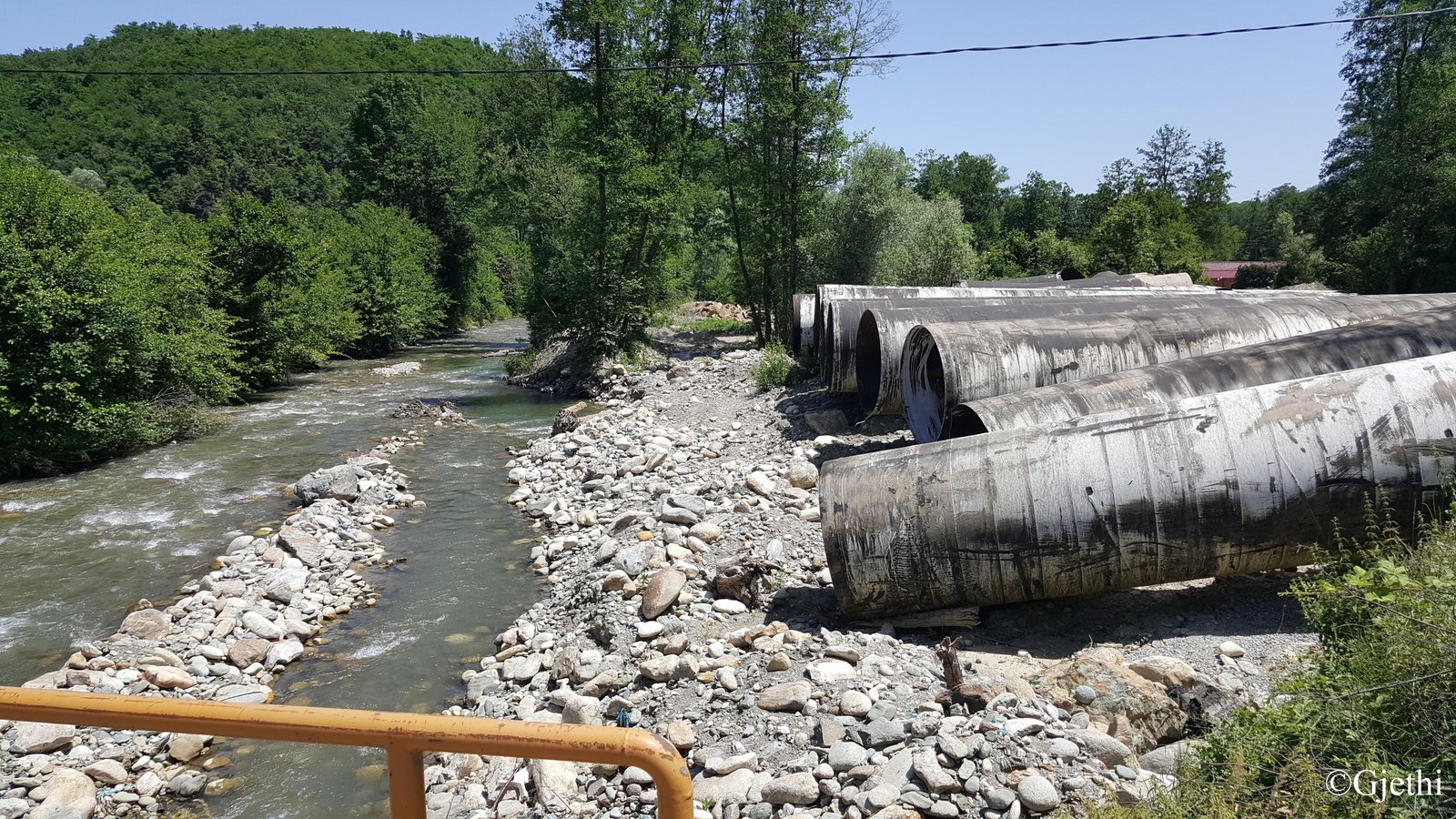

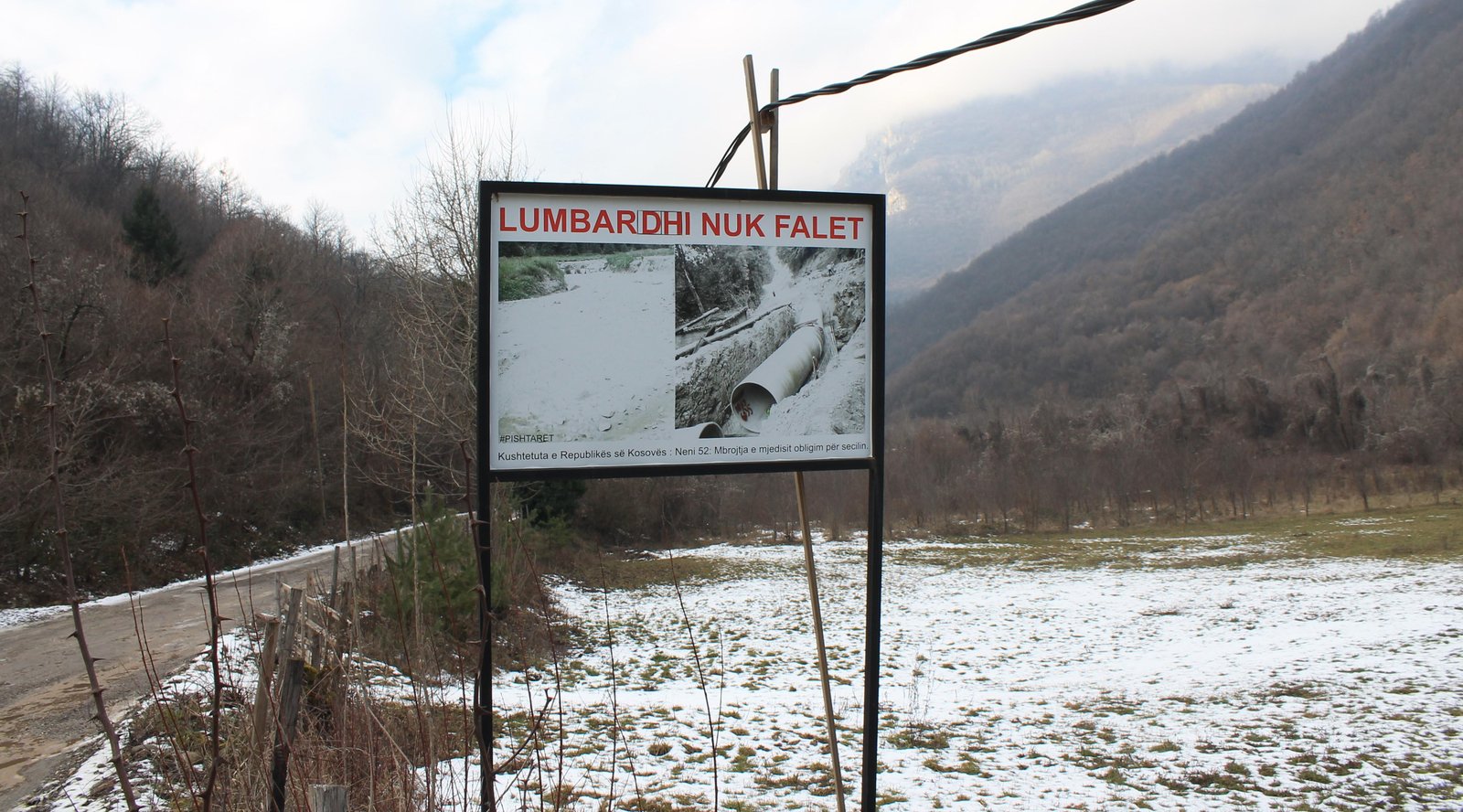
On 1 June 2020, the company Kelkos sued activist Shpresa Loshaj, demanding 100,000 euros. The company raised several allegations of defamation and reputational damage based on statements Loshaj had made publicly, as well as in some letters she sent to the relevant institutions.
“Moreover, on 13 May 2020, on her Facebook profile, the defendant shared a video, contesting the legality of the plaintiff’s hydropower plants, and stating that the plaintiff is contributing to the destruction of the environment and nature, all of this in the absence of an Environmental Permit,” the Kelkos lawsuit states, among other things.
The response to the lawsuit was immediate from lawyer Rina Kika. She listed a series of facts and arguments showing that the plaintiff’s claims are unfounded, and she also presented official communications from Kosovo institutions regarding the damage caused during the construction and operation of the hydropower plants.
The response to the lawsuit emphasizes that in this case, Loshaj’s statements regarding the operation of Kelkos’s hydropower plants without a license and without an environmental permit are based on official public information published by the Energy Regulatory Office, which was specifically compiled for the hydropower plants operated by Kelkos in Deçan Gorge.
“As for the claim that the defendant defamed the plaintiff by stating that the plaintiff did not have an environmental permit, on the one hand the plaintiff characterizes as defamation the defendant’s statement that the plaintiff does not possess an Environmental Permit (see Defamation Lawsuit, paragraph 1.5), while on the other hand it contradicts itself by admitting that it does not possess an Environmental Permit (see Defamation Lawsuit, paragraph 1.15),” the response to the lawsuit states, among other things.
The response further emphasizes that Loshaj’s statements, as factual assertions, enjoy protection under the standards established by the European Court of Human Rights (ECtHR), whose practice prevails in our domestic law under Article 53 of the Constitution.
It states that this lawsuit is considered a SLAPP (Strategic Lawsuits Against Public Participation) and said that environmental damage and company accountability for causing it are matters of public interest, so public debate on this issue must not be hindered or discouraged by approving SLAPP lawsuits.
Kelkos’s lawsuit also did not spare Adriatik Gacaferri, who had photographed the Lumbardhi II hydropower plant and the dry river, posting it on Facebook and expressing his dissatisfaction and concern about the situation. Unlike Loshaj, who was being asked for 100,000 euros, Gacaferri, who was sued on 9 July 2020, was sued for 10,000 euros in damages.
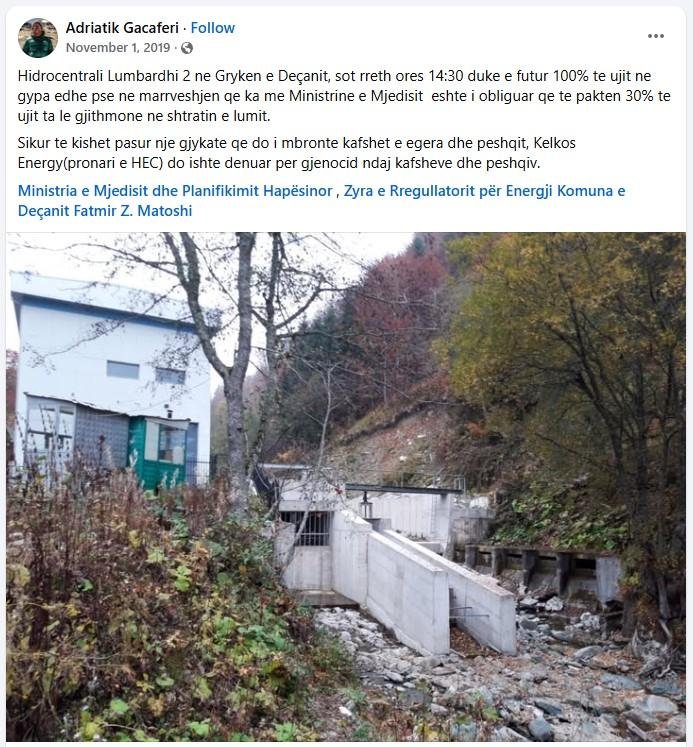
The Kelkos lawsuit states that Gacaferri’s statement culminated in damage to their reputation as a respected enterprise in Kosovar society and a major investor in green energy in Kosovo.
The lawsuit states that Kelkos can prove that on the day the defendant posted the photo and updated the status on Facebook, the Lumbardhi II hydropower plant was out of operation. According to them, this made it impossible for any amount of water to have gone into the pipes.
“On the contrary, the valves of HEC Lumbardi II left 100% of the water in the Lumbardhi River untouched,” the lawsuit states, among other things.
Meanwhile, in the response to the lawsuit prepared by lawyer Rina Kika, it is emphasized that Gacaferri’s statement is protected under freedom of expression as a fundamental human right guaranteed by Article 40 of the Constitution of the Republic of Kosovo.
The response to the lawsuit said that Gacaferri’s statement is legally protected, because the first part constitutes a statement of public interest, while the second part is an expression of opinion, and therefore both are examined separately.
It is stressed there that Gacaferri’s statement is protected as a statement made on a matter of public interest, for which he cannot be held liable for defamation because he supported his claim that 100% of the water went into the pipes by observing the place where he took the photograph.
Regarding this issue, Preportr contacted Adriatik Gacaferri, but he did not want to speak and said that for several years he has not been dealing with the hydropower plant issue.
Kelkos: We withdrew the lawsuits
On 20 October 2021, the ad hoc coalition of civil society organizations and activists announced that Kelkos had withdrawn its defamation lawsuits against Shpresa Loshaj and Adriatik Gacaferri. The withdrawal of the lawsuits came after a major public debate and many reactions related to the issue.
Lawyer Rina Kika said that Kelkos knew it could not win these baseless lawsuits in court and that the goal was never for them to win the case; the goal was to intimidate the activists who criticize the company’s operations.
“They withdrew both lawsuits, without any conditions and immediately. Lawsuits like these, which try to silence public debate on matters of public interest such as environmental protection, are harmful and should be strongly opposed by everyone,” Kika said.
Nico Kollmann from Kelkos said the lawsuits against Shpresa Loshaj and Adriatik Gacaferri were withdrawn voluntarily, “with the aim of de-escalating tensions and creating space for a more constructive and fact-based dialogue.”
Asked whether these were SLAPP lawsuits intended to frighten activists into avoiding the issue, he said that description is inaccurate and that the legal actions were taken to protect their legitimate rights and reputation against false accusations, in accordance with the applicable law.
The FOL Movement was engaged in defending the two environmental activists. Mexhide Demolli, director of this organization, said that together with other civil society organizations, they assessed these lawsuits as SLAPP.
“The sums requested as compensation were tools to exert financial and psychological pressure on individuals who criticized the operations of ‘Kelkos Energy’ in Deçan Gorge,” said Demolli.
She said these lawsuits have a chilling effect on society. Even though in this case activists like Shpresa Loshaj showed courage and did not back down, it was Kelkos that withdrew the lawsuits after strong pressure from civil society.
The sums requested as compensation were tools to exert financial and psychological pressure on individuals who criticized the operations of ‘Kelkos Energy’ in Deçan Gorge.
“There is concern that these lawsuits may cause other activists to self-censor, out of fear of long court proceedings and high costs. What is already known is that the purpose of SLAPP lawsuits is not justice, but to tire out and exhaust the resources of those who dare to speak,” Demolli stressed.
Loshaj: They tried to silence me and intimidate those who might speak
Shpresa Loshaj told us about her experience with the lawsuit filed against her. She found it strange and shocking that a foreign company could come and file baseless lawsuits and try to silence the citizens of Kosovo. Loshaj said that, on the one hand, she understood why many people in Kosovo are afraid to speak openly, but on the other hand, she was pleasantly surprised by the support she received from civil society.
She said that initially she did not feel any hesitation or fear because she had the facts on which she had spoken and built her activism for the protection of the Lumbardhi i Deçanit.
Meanwhile, she said she began to understand what was happening with Kelkos’s cases in the courts of Peja and Deçan. She said she learned that a citizen of Deçan was fined because he had tried to remove Kelkos machinery from his meadow, after they had entered without permission and without his knowledge to open canals on his property.
“The judge who had my case in Deçan imposed that fine, reasoning that the citizen had raised his voice while communicating with Kelkos workers,” she tells us.
Loshaj said that when she saw this case, it became clear to her that such decisions sent a message to the citizens of Deçan to remain silent.
“I think that is exactly how the silence began that covered Deçan for a long time,” she said, adding that through this lawsuit they wanted to make sure not only to silence her, but to intimidate everyone who might speak.
“Some voices that were once very loud in defense of the Lumbardhi have today almost disappeared. This shows that the pressure and fear created by such lawsuits can make people step back or stay silent, even when they know the cause is just,” Loshaj said.
She told us that other citizens also advised her to be careful because there could be various consequences, even ending up in prison. According to her, this was an indicator of citizens’ trust in the justice system.
Some voices that were once very loud in defense of the Lumbardhi have today almost disappeared. This shows that the pressure and fear created by such lawsuits can make people step back or stay silent, even when they know the cause is just.
“When people do not trust the courts, the fear of such lawsuits becomes even greater, and in this case the fear was real,” said Loshaj.
According to her, Kelkos knew that its influence would not have an effect on her, because she did not live in Kosovo, and her life, work, and family were in Canada, so they had no way to pressure her through work or family members. Nevertheless, she said there were indirect pressures, as well as various threats, which began at the door of her home.
“Some people from my village also felt pressure from Kelkos, or more precisely from the Municipality of Deçan, which saw my activism as a threat. There were several occasions when various methods were used to silence me, which even put my life at risk,” said Loshaj, adding that she was fortunate to always be accompanied by her husband. Meanwhile, she said she was constantly careful in her movements.
“Maybe a time will come when I will be open about those experiences,” she said.
Read the full investigation:
Artikuj të ngjashëm